- Hotels
- Rent-A-Car
- Routs
Tourism permits in Angola: a measure that could strangle the market
Recently, new legislation related to licenses for the tourism sector was approved in Angola, covering travel agencies, hotel units, and restaurant establishments.
At first glance, the measure appears to aim at organizing the sector and creating a clearer licensing framework. However, when looking carefully at the values and the adopted model, an essential question arises:
are we structuring the sector or are we making its growth more difficult?
An expensive license in a market still under construction
In the case of travel agencies, license values exceed 5 million kwanzas to operate legally.
For a country where tourism is still in a growth phase, and where many companies are small or family-run, this amount represents an extremely high initial investment.
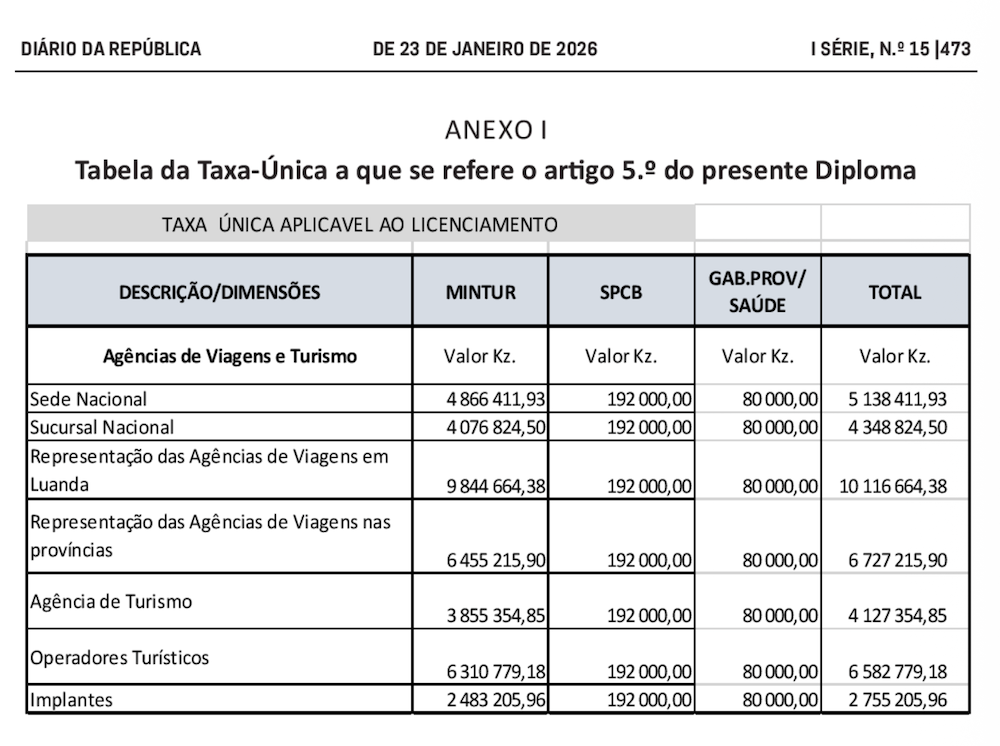
And here an obvious problem emerges: when the cost of entering the market is very high, what usually happens?
Many operators simply choose to continue operating informally.
And anyone familiar with the tourism sector in Angola knows this is not a hypothetical scenario. There are currently several entities selling travel, organizing excursions, or promoting tourism experiences without any formal licensing.
Instead of helping to formalize the sector, a fee that is too high may reinforce exactly what it intends to combat.
DIY Itineraries

Luanda Historical and Cultural Tour

Wonders of the Desert Itinerary

Huila Wonders Tour

Itinerary from Menongue to Lubango

Cuito Cuanavale itinerary

Saco Mar itinerary

Moçâmedes Basic Route

Basic Caotinha Route

Huambo Basic Route

Lubango Basic Route

Wonders of Malanje Tour

Beaches in the South of Benguela

Catumbela itinerary

Dombe Grande itinerary

Benguela City Tour

Conda's itinerary

Itinerary to Egypt Beach

Lobito City Tour

Route from Huila to Chibia

Humpata itinerary
What kind of agencies do we want? Those that sell tickets simply to generate cash flow and ensure their sustainability, or those that invest in the domestic market through hard research work and dedicate themselves to innovating and building different solutions and experiences?
A measure that prioritizes immediate revenue
Another aspect that deserves reflection is the adopted model.
The license is paid only once, after which the company is allowed to operate for a practically unlimited period.
This raises a strategic question: was the system designed to develop the sector or to generate immediate revenue?
In practice, what may happen is simple:
- the current ministry collects a significant amount now,
- in the future there will no longer be a continuous source of funding for the sector.
- the total initial cost is approximately around 3,000 euros (3.26 minimum wages in Portugal, about 2.7 million kwanzas at an approximate exchange rate).
- Even in more demanding systems, the licensing fee may be close to 12,469 euros, depending on the license framework and the type of activity.
But there is a fundamental difference:
- these countries have mature tourism markets, with millions of tourists per year, high demand, and companies with greater financial capacity.
- Angola is still in an early stage of tourism development.
- Therefore, copying the model without adapting it to the context may produce exactly the opposite effect of what is intended.
A more sustainable alternative model
Perhaps the question we should ask is different:
how can we create a system that encourages formalization while at the same time financing the sector?
One possibility would be to adopt a more progressive model, for example:
- a more accessible initial fee
- combined with an annual activity fee.
This model would have several advantages:
- it would reduce the barrier to entry into the market
- it would encourage the formalization of companies
- it would create a permanent source of funding for the sector
- it would allow more regular monitoring of licensed companies.
Packs

EXCLUSIVE HOTELS ANGOLA VOUCHER
Over the years, the State could collect more resources than with a single payment, but without strangling the market.
Developing tourism requires facilitating investment
Angola has extraordinary tourism potential:
- unique nature
- rich culture
- extensive coastline
- destinations that remain authentic.
Creating barriers that are too high right at the start can have a complicated effect: instead of energizing the sector, it may reduce the number of formal companies and hinder innovation.
A necessary debate
Organizing the tourism sector is fundamental. But regulating does not necessarily mean making access to the market more expensive.
The real challenge lies in finding the balance between:
- regulation
- institutional sustainability
- and sector growth.
Because in tourism, more important than collecting millions today is creating a strong sector that generates value for decades.
And for that, it may be necessary to reconsider whether this licensing model is truly the most suitable for Angola’s reality.
Sincerely
Jorge Nunes
www.hoteisangola.com

+ Traveler Article
-
 Hunting activity generates extreme opinions, but, when properly regulated and based on scientific criteria, it can help finance conservation, control animal populations and preserve natural areas a...
 -
 The second largest hotel market in Angola brings together an international airport, port, railway, beaches and thousands of jobs, but remains outside of some of the main structural investments in n...
 -
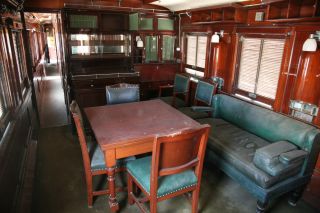 When, once again, the Rovos Rail train arrives in Lobito, after a journey that connects Dar es Salaam to Lobito, we are forced to ask a simple question: after all, what tourism are we truly buildin...
 -
 Between the announced growth, the reality of entries into the country and the structural challenges of Angolan tourism
 -
 The 5% tax on foreigners' stays: another cost for tourism that still needs bases
Newsletter - Promotions and highlights in your email
Support Line
 WhatsApp
 Telephone
 Email
Email
Available every day from 8:00 AM to 10:00 PM. Allows you to clarify doubts, support reservations, and guide you in choosing the best accommodation and tourist services.