- Hotels
- Rent-A-Car
- Routs
Angola is one of the most exciting and least visited birding countries in Africa. Sheltered within its generous borders is a multitude of habitats: Desertos no sudoeste; savanas áridas no sul; montanhas no oeste, com florestas e pastagens associadas de Afromontane; floresta de planícies tropicais no norte e Cabinda; floresta sub-montana ao longo da escarpa, e vastas áreas de bosques de Miombo de folhas largas na maior parte do leste. O que é a observação de Aves? A observação de aves é o passeio de ecoturismo que tem como objetivo observar as aves em seu habitat natural, sem interferir no seu comportamento ou no seu ambiente. O roteiro constitui uma forma legítima de exploração ecoturística das áreas naturais, visto ser uma prática de baixo impacto. O público que procura este tipo de atividade é um público específico que possui alto grau de consciência ambiental, estando atento e adotando seriamente as práticas de mínimo impacto em ambientes naturais.
Uma espécie endêmica é aquela espécie animal ou vegetal que ocorre somente em uma determinada área ou região geográfica. O endemismo é causado por quaisquer barreiras físicas, climáticas e biológicas que delimitem com eficácia a distribuição de uma espécie ou provoquem a sua separação do grupo original.
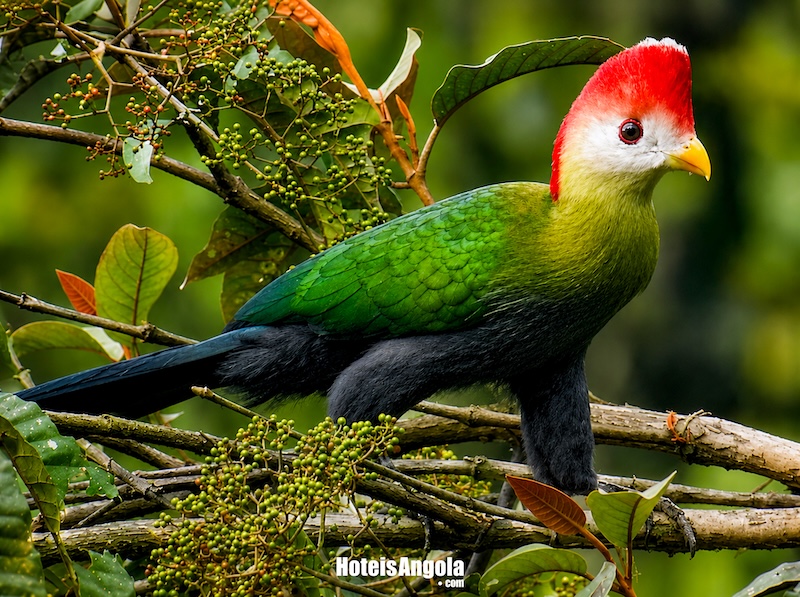
Existe uma lista de pássaros de mais de novecentas e vinte espécies, mas há pouca atividade ornitológica. O African Bird Club e a Birding Africa têm desenvolvido algumas actividades. O Tauraco erythrolophus, (Tauraco-de-crista-vermelha), é um pássaros frugívoro endémico de Angola. Pertence ao género tauraco um grupo muito semelhante aos passeriformes de África e pertence à família dos Musophagidae. O seu trinado soa um pouco como o do macaco da floresta. Vive nas florestas e savanas de Angola, Zaire e do sudoeste africano. Tem na cabeça uma crista vermelha emplumada como uma coroa. As narinas são redondas. Entre machos e fêmeas, não há diferença no tamanho e na cor. A cor básica da plumagem é verde metálico e azul. Devido à sua plumagem, é muito difícil de ser visto nas árvores. Mede cerca de 40 centímetros. O Tauraco-de-crista-vermelha vive sobretudo na copa das árvores e raramente desce. Ele é um excelente trepador e vive entre as árvores. a sua dieta consiste em frutos, bagas, sementes, caracóis e insectos. Durante a corte, ele aponta a crista de forma dinâmica e eriça as penas. Normalmente vive como casal, raramente como uma pequena aliança familiar. Em caso de perigo, mantém-se imóvel e foge na oportunidade mais favorável. A ninho é composto por dois ovos e é construído nos ramos densos. Ambos os pais chocam os ovos que eclodem ao fim de três semanas. Após quatro semanas, os jovens deixam o ninho.Birdwatching in Angola
Com possibilidade de se desenvolverem vários passeios em locais como a kumbira, Morro do Moco, Twndavala, etc.... Angola propicia aos seus visitantes a possibilidade de observar diversas Aves endêmicas.
O que é uma Espécie Endêmica?
Quando a separação ocorre por um longo período, o grupo isolado sofre uma seleção natural que desenvolve nele uma diferenciação de outros membros da espécie. O ambiente isolado tem características de clima, solo e água distintos dos demais e seleciona as espécies que lá vivem de uma forma única: determinadas espécies só se desenvolverão naquele ambiente.
Por isto, quanto maior for o grau de especificidade do ambiente, maior o grau de endemismo - isto é, maior o índice de espécies endêmicas.
Angola tem uma série de espécies endêmicas e quase endêmicas para atrair ornitólogos, observadores de pássaros e lores.
Muitas das espécies endêmicas próximas, como a Bustard Ruppell Eupodotis rueppellii, o Parrot Poicephalus ruepellii de Ruppell, o Lovebird de Rosy Agapornis roseicollis, Swift Apus bradfieldi de Bradfield, Violet Wood-hoopoe Phoeniculus damarensis, Hornbill de Monteiro Tockus monteiri, Lark Ammomanopsis grayi, Benguela Long- Lark Certhilauda benguelensis, Carpe's Parus carpi, Babbler Turkeides ginásios de turdoides e Shrike de cauda branca Lanioturdus torquatus são mais fáceis de ver e mais simples.
Será necessário viajar em Angola, para ver o francóculo Francolinus griseostriatus endêmico com franjas de cinza, o francolinus swierstrai de Swierstra, que foi redescoberto recentemente após um período de 40 anos, Mousebird Colius castanotus com crista vermelha, Turaco Tauraco erythrolophus com crista vermelha , Angola Slaty Flycatcher Melaenornis brunneus, White-face Olho-olho Platysteira albifrons, Gabela Bush-Shrike Laniarius amboimensis, Monteiro's Bush-Shrike Malacanotus monteiri, Gabela Helmet-Shrike Prionops gabela, Gabela Akalat Sheppardia gabela, Longbow de Pulitzer Macrosphenus pulitzeri e Montane Double- Colmilho Sunbird Cinnyris ludovicensis.
Outras espécies prezadas incluem Angola Cave-Chat Xenocopsychus ansorgei, White-headed Robin-Chat Cossypha heinrichi, Cisticola Cisticola melanurus de cauda fina e Bocage's Sunbird Nectarinia bocagii.
A maioria dessas espécies endêmicas foi vista na turnê ABC, bem como muitas outras espécies de espécies interessantes e limitadas.
Tauraco com crista vermelha é um dos atractivos endemicos
Localização
Map
What is Bird Watching?
Bird watching is an ecotourism tour that aims to observe birds in their natural habitat, without interfering in their behavior or in their environment. The roadmap is a legitimate form of ecotourism exploration of natural areas, as it is a low-impact practice. The public that seeks this type of activity is a specific audience that has a high degree of environmental awareness, being attentive and seriously adopting practices with minimal impact on natural environments.
What is an Endemic Species?
An endemic species is an animal or plant species that occurs only in a certain area or geographic region. Endemism is caused by any physical, climatic and biological barriers that effectively delimit the distribution of a species or cause it to separate from the original group. When the separation occurs for a long period, the isolated group undergoes a natural selection that develops a differentiation from other members of the species. The isolated environment has characteristics of climate, soil and water that are different from the others and selects the species that live there in a unique way: certain species will only develop in that environment. For this reason, the greater the degree of specificity of the environment, the greater the degree of endemism - that is, the greater the index of endemic species.
There is a list of birds of more than nine hundred and twenty species, but there is little ornithological activity. The African Bird Club and Birding Africa have developed some activities.
Angola has a series of endemic and almost endemic species to attract ornithologists, bird watchers and flowers. Many of the nearby endemic species, such as Bustard Ruppell Eupodotis rueppellii, Parup Poicephalus ruepellii by Ruppell, Lovebird by Rosy Agapornis roseicollis, Swift Apus bradfieldi by Bradfield, Violet Wood-hoopoe Phoeniculus damarensis, Hornbilli Monteiro, Hornbill de Montemari Benguela Long- Lark Certhilauda benguelensis, Carpe's Parus carpi, Babbler Turkeides turdoides and white tailed Shrike Lanioturdus torquatus are easier to see and simpler.
It will be necessary to travel in Angola to see the endemic Francolinus griseostriatus endemic with gray fringes, the Swierstra francolinus swierstrai, which was recently rediscovered after a period of 40 years, red crested Mousebird Colius castanotus, red crested Turaco Tauraco erythrolophus, Angola Slaty Flycatcher Melaenornis brunneus, White-face Eye-eye Platysteira albifrons, Gabela Bush-Shrike Laniarius amboimensis, Monteiro's Bush-Shrike Malacanotus monteiri, Gabela Helmet-Shrike Prionops gabela, Gabela Akalat Sheppardia gabela, Pulitzer Machalusus Longbow and Macronus Pulitzer Sunbird Cinnyris ludovicensis. Other prized species include Angola Cave-Chat Xenocopsychus ansorgei, White-headed Robin-Chat Cossypha heinrichi, Cisticola Cisticola thin-tailed melanurus and Bocage's Sunbird Nectarinia bocagii.
Most of these endemic species were seen on the ABC tour, as well as many other interesting and limited species.
Tauraco with red crest is one of the endemic attractions
The Tauraco erythrolophus, (Red-crested Tauraco), is a frugivorous bird endemic to Angola. It belongs to the genus tauraco a group very similar to the passerines of Africa and belongs to the family of Musophagidae. His trill sounds a little like that of the forest monkey. It lives in the forests and savannas of Angola, Zaire and southwest Africa. It has a red crest feathered on its head like a crown. The nostrils are round. Between males and females, there is no difference in size and color. The basic color of the plumage is metallic green and blue. Due to its plumage, it is very difficult to be seen in the trees. Measures about 40 centimeters. The red-crested Tauraco lives mainly in the treetops and rarely goes down. He is an excellent climber and lives among the trees. their diet consists of fruits, berries, seeds, snails and insects. During the court, he dynamically points the crest and raises the feathers. Usually lives as a couple, rarely as a small family alliance. In case of danger, he remains immobile and flees at the most favorable opportunity. The nest consists of two eggs and is built on dense branches. Both parents hatch the eggs that hatch after three weeks. After four weeks, the young leave the nest