- Hotels
- Rent-A-Car
- Routs
Carnival in Angola
The first sketches of Entrudo revelry were gradually introduced into the Kingdom of Kongo from the very first contacts between the Portuguese and the peoples of the basin of the great river “N’zadi,” the Zaire. The first peoples to follow this type of expression were the N’Zombo on the southern bank of the N’Zaire and the N’Zaus on the northern side of the same river, those now called Cabindans, the Lândanas and the Inbindas of that time. Later, the N’Zeto of Songo and Solongo, further south in the Kingdom of Manikongo, also joined in this playful way of life.
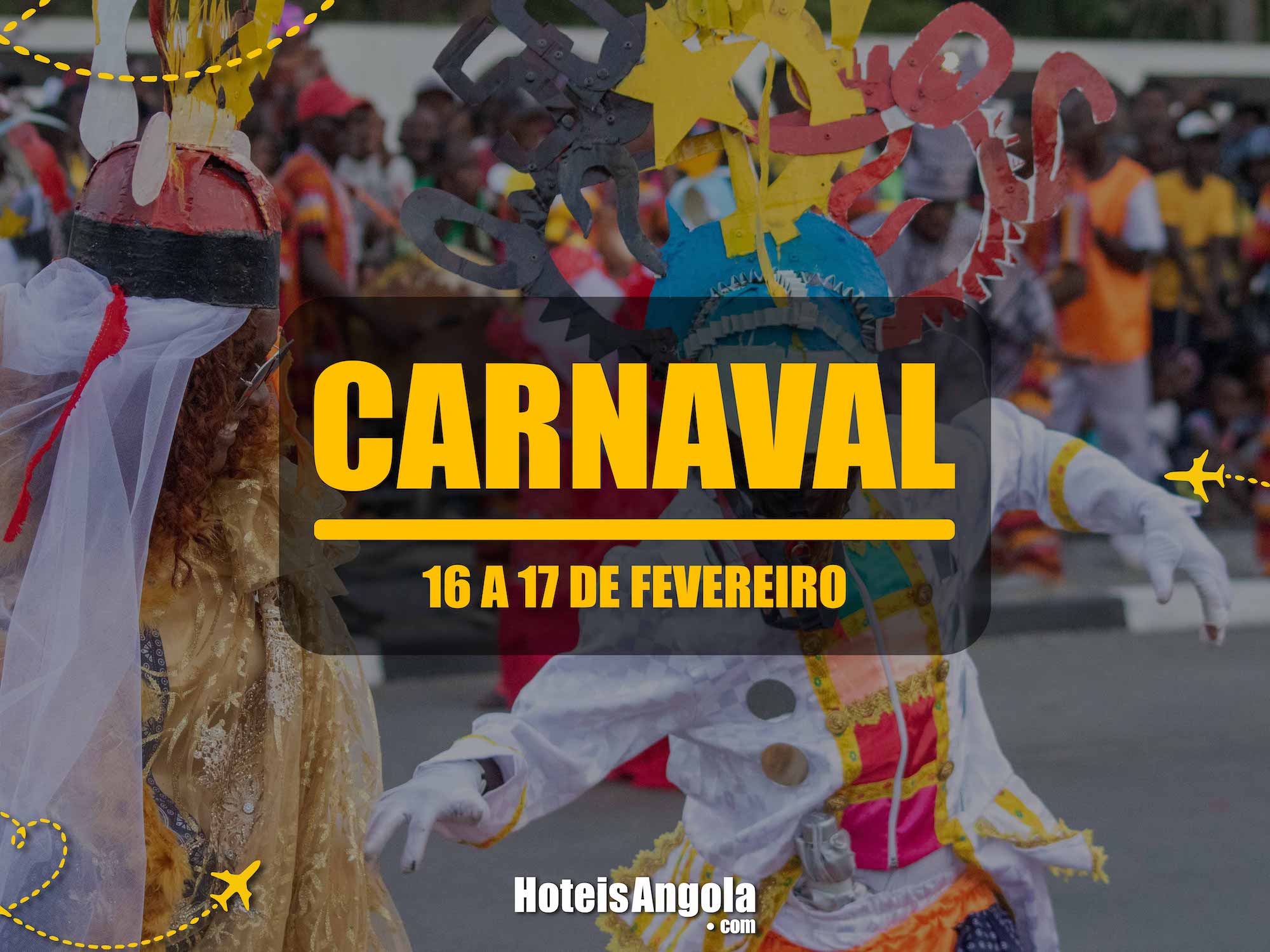 With the mercantile expansion of the various trading posts, and further south, the Tugas simultaneously carried these customs along the coast south of present-day Ambriz to the Kingdom of N’Dongo (the name of the first canoes and peoples), which came to be known as N’gola and later Angola.
The natives of the Island of Goats or the Muxiloandas of Mazenga Island, present-day Luanda Island, turned this expression into a form of entertainment combined with a dance known as bassula, esquindiva or finta.
With ornaments of ribbons and branches, they imitated the new beings of white skin, the N’Dele or T’chindele with hats and iron armor.
This was followed by a rapid semantic evolution of language and slang characterized by the camondongos or Kaluandas, a mixture of Kimbundu and Portuguese.
The Muxiluandas gave the name Muala to that dance, already with some choreography and in a pre-merengue rhythm. Semba emerged from the Kazukuta dance, in a place known as Samba;
Soba Samba himself, allied with Manhanga (Maianga), gave vitality over the years to such manifestations of popular revelry.
Those manifestations, from 1800 onwards, already had great moments of recreation and choreography. Very close to the end of the 19th century, muceques with names such as Kamama, Kapiri and Mulenwo emerged, which, in funeral manifestations, appealed to the spirit “Kiruwala,” displaying gestures of near recreation that the Muxiloandas or Axiluandas used to demonstrate fraternity and social support.
From the 1930s onwards, the inhabitants of the Island would come by canoe to the Marginal, which came to be called Paulo Dias de Novais, and imitated the Portuguese sailors with their immaculately white uniforms, swords, yellow insignia and matching hats.
They held revelry washed down with T’chissângua and vinho do Puto that the “N’Gwetas” brought from the metropolis; these were times of festivity that the N’Gwetas granted to their workers, market women and farm women so they could lounge on the sands of the Marginal.
The colonial settlers, roçeiros, fubeiros or civil servants laughed and, on the sly, in the backyards of their farms or houses, held “arrebenta merengue” parties under a mulembeira, almond tree, tamarind tree or even a baobab; it was an appropriate time for the “N’Dele” maidens, Creoles and servant girls to meet, to talk about matters of literature.






The manifestations of Saturn and Bacchus proliferated from the muceques of Sambizanga, Prenda, Catambor, Bairro Operário, São Paulo, Kaputo da Terra Nova, Cazenga, Rangel and the aforementioned fishermen of the Island, the Muxiloandas. The Kaluandas, always ready for revelry, along with the curious from Kifangondo, Cacuaco, Catete, Barra do Kwanza, Belas, Maculusso, Praia do Bispo and Bungo.
1961 arrived on the fourth day of February, and the colonial authorities suspended all street manifestations. Timidly, in the backyards and almost in hushed tones, revelries were held in Samba, Coqueiros, Bairro do Café, Vila Alice, Quinaxixe and Maianga; these were remnants of the June festivities in honor of the popular saints that whites and Creole sons held with regulations, lyrics and music and a prize from the Municipality of Luanda.
After 1961, notwithstanding the authorities’ prohibition of festive manifestations, attempts at disobedience were recorded in São Paulo, Anangola, Bairro Operário and Bairro do Cruzeiro, from which disturbances arose with heavy repression by militarized forces.
It was revenge for the deaths of some policemen during the assault on the Fourth Police Station by enthusiasts of the glorious EME, followed by raids and dogs unleashed to seize Black people (things to forget, even foolish, but… difficult to understand). It was the beginning of the armed struggle, the revolt of the persecuted in times of “qwata-qwata,” and behold, in 1965 the Angola Information and Tourism Center (CITA), jointly with the Municipal Council, regulated the participation of blocks coming from the suburbs to cheer the people on the Marginal Avenue.
There was no longer sand; there already existed the Bank of Angola, the fishing pier and many imperial palm trees adorning a wide paved and asphalted promenade from the Fortress of São Miguel in Baleizão to the seaport of Bungo with its imperial square and the statue of the Navigator Paulo Dias de Novais (this statue should return to its place).
The groups paraded in corso, masked, with painted cans, whistles, colorful garments imitating Kings of the distant Puto, and many swords, spears, shields and crowns; on that day everyone was a king… whoever wished to be!
The kingdoms of N’gola and Kongo were always represented.
The city of Lobito joined the festivities, and on Restinga Island the corso passed, pouring kilos and kilos of fuba to turn everyone white, and behind it, a jet of water fixed the white mask with figures of sinister appearance. On that day, everyone was white and zombies.
Later, N’gola Ritmos, Os Cunhas, the Rok’s and Duo Ouro Negro emerged. They were followed by Lubango, Benguela of the red acacias, Huambo, Sumbe and many other localities until the Carnation Revolution arose on April 25, 1974, led by a handful of senior officers of the Portuguese Armed Forces, whose results reverberated in the Portuguese colonies in Africa until the proclamation of their independence.
Carnival, which has already become one of the most popular festivities in the country, recorded several interruptions in its history. The first occurred in the 1940s with the outbreak of World War II; the second between 1961 and 1963, with the beginning of the national liberation struggle, a period during which there was also no Carnival by decree of the Salazar regime; and a third occurred between 1975 and 1977.
The resurgence of Carnival festivities in the then People’s Republic of Angola was led, in 1978, by the Founder of the Nation and first President of Angola, Dr. António Agostinho Neto.
At a very popular rally held in one of Luanda’s most emblematic municipalities (Cazenga), the Poet-President proposed to the country’s population that Carnival be held from a different perspective than that previously known.
The reinstatement of Entrudo as a public festival and popular recreation was conceived by Agostinho Neto, with the aim of lifting the population out of the lethargy that completely absorbed their daily activity.
Thus, the history of post-independence Carnival is intrinsically linked to the figure of Agostinho Neto who, with his popular and promising discourse, called on Angolans to celebrate the victories achieved by the country, thus designating it the Carnival of Victory. This was the predominant tone of Carnival for many years.
In addition to his training in Medicine, his literary vein and his desire to see the right to life be irrefutably respected, he rescued the country’s cultural legacy, as can be read in his poem from the book Sagrada Esperança, entitled Havemos de Voltar:
«To the marimba and the quissange, to our Carnival we shall return»
+ Info news article
-
 The Huíla Tourist Map project was presented on September 15th, in the Huíla Provincial Government Auditorium, in a session dedicated to sharing the work developed and collecting contributions for i...
 -
 Hotels bear commissions on funds allocated to the State, while tourists are forced to look for cash, facing discomfort and possible security risks.
 -
 O turismo angolano encontra-se num momento decisivo. Nos últimos anos foram alcançados alguns progressos, mas continuam a existir desafios estruturais que condicionam a competitividade do sector e ...
 -
 A entrada em vigor da Contribuição Especial para o Turismo, correspondente a 5% sobre as estadias de turistas internacionais, continua a levantar inúmeras dúvidas entre hotéis, aparthotéis, pousada...
 -
 The project aims to provide visitors with essential information about the territory's main attractions.
Newsletter - Promotions and highlights in your email
Support Line
 WhatsApp
 Telephone
 Email
Email
Available every day from 8:00 AM to 10:00 PM. Allows you to clarify doubts, support reservations, and guide you in choosing the best accommodation and tourist services.