- Hotels
- Rent-A-Car
- Routs
Tchitundo-Hulo
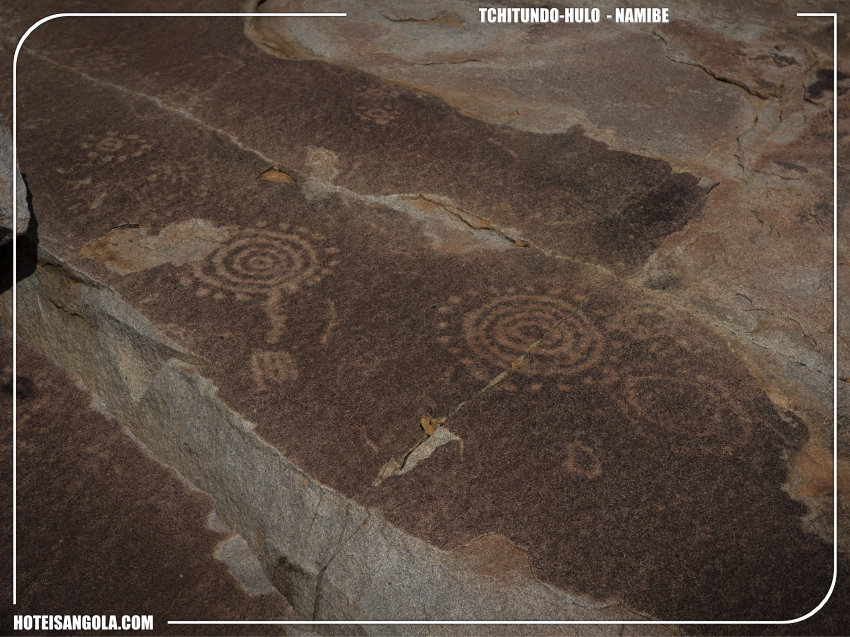
The Tchitundo-Hulo rock complex, in Capolopopo, is one of the most valuable cultural treasures in Angola.
We turn the compass to the south in search of answers.
Many, many years ago, the rock walls of the southern desert became a canvas, a huge outdoor mural with thousands of colorful figures.
Mostly abstract and circular drawings – perhaps the universe itself, the cosmos seen in the clear desert nights -; a few others, more recognizable, with antelopes and snakes marking the feature.
The Tchitundo-Hulo rock complex, in Capolopopo (municipality of Virei, Namibe), is one of the most valuable cultural treasures in Angola.
The impressive number of engravings date back to remote times – some say 2000 years, some say 4000 – and occupy several stations: Tchitundo-Hulo Mulume, the first to be found; Tchitundo-Hulo Mucai and Pedras da Lagoa and Zebras. There are granite hills, ceilings and walls dotted with stories still to be deciphered today.
The engravings began to be studied in 1952, by Camarate França. A thousand and one theories have since emerged to explain this masterpiece of the desert people.
Everything indicates that the place was an important crossing point for the first inhabitants of the region, the Cuissis. People before the arrival of the Bantu who may have chosen the place as a camp or ritual cathedral.
But that was just the zero point, the most fascinating thing about Tchitundo-Hulo is that it marks a strong tradition of thousands of years.
Academics say that the diversity of features, the greater or lesser visibility of the engravings is a sign that since From the first people to more recent times, the Tchitundo-Hulo hill never stopped being painted.
Prehistoric and contemporary, Cuissi and Herero, the before and after represented there.
In fact, the Tchitundo-Hulo station could be a simple piece of a huge puzzle that covers Namibe, authorities have already identified a total of 18 similar archaeological stations in the region, some hundreds of kilometers apart.
The challenge of identifying points of interest, along with preservation, the erosion of the rocks, vandalism by people who do not understand the value of the engravings, and the lack of measures to conserve the place threaten the ancient history of Tchitundo-Hulo.
The official plaque inaugurated by the government is there, marking the intention. But that's not enough.
Circumferences, straight lines, maps of the sky and stars that have covered the desert for thousands of years.
Ritual eyes, places of passage and sambos that no longer exist, people from beyond before, before and after.
Everyone gathered in the same place with their thoughts and ways of seeing the world.
This place is magical and hides answers to eternal questions.
Frequented since ancient times, Tchitundo-Hulo belongs to a vast region that is beginning to be seen by some scientists as the true cradle of Humanity.
Our southern lands can thus hide, beneath the dry land, the key to life, the beginning of Man.
Travel through the desert and help spread and conserve this part of our History.
Angola did not begin with the Bantu kingdoms of Kongo or Ombaka.
There were other kings before the Manikongos, Jinga and Ngola Kiluanji.
The fingerprints of the first inhabitants of what is now our country are there. Discover them.
Localização
- Localiddae: Tchitundo-Hulo
- Municipio: Virei, Capolopopo
- Provincia: Namibe
- Coordenadas GPS: -15.93807402021135, 12.876995699139938
Map
Many, many years ago, the rock walls of the southern desert became canvas. A huge outdoor mural with thousands of colorful figures. The majority, abstract and circular designs - perhaps the universe itself, the cosmos seen on clear desert nights -; others, more recognizable, with antelopes and snakes marking the line.
The Tchitundo-Hulo rock complex in Capolopopo (municipality of Virei, Namibe) is one of the most valuable cultural treasures in Angola. The impressive quantity of engravings dates from remote times - some say 2000 years, some say 4000 - and occupy several stations: Tchitundo-Hulo Mulume, the first to be found; Tchitundo-Hulo Mucai and Pedras da Lagoa and Zebras. There are granite hills, ceilings and walls sprinkled with stories yet to be deciphered.
The engravings began to be studied in 1952, by Camarate França. A thousand and one theories have since emerged to explain this masterpiece of the peoples of the desert.
Everything indicates that the place was an important crossing point for the first inhabitants of the region, the Cuissis. People prior to the arrival of the Bantu who may have chosen the place as a camp or ritual cathedral.
But that was just the zero point. The most fascinating thing about Tchitundo-Hulo is that it marks a strong tradition of thousands of years. Academics say that the diversity of features, the greater or lesser visibility of the engravings is a sign that since the first peoples until more recent times, the hill of Tchitundo-Hulo has never stopped being painted. Prehistoric and contemporary, Cuissi and Herero, the before and after represented there.
In fact, the Tchitundo-Hulo station can be a simple piece of a huge puzzle that covers Namibe. Authorities have already identified a total of 18 similar archaeological sites in the region, some hundreds of kilometers away. The challenge of identifying points of interest adds to the challenge of preservation. The erosion of rocks, the vandalism of people who do not understand the value of the engravings, and the lack of measures to preserve the place threaten the ancient history of Tchitundo-Hulo. The official plaque opened by the government is there, marking the intention. But that is not enough.
Circles, straight lines, maps of the sky and the stars that have covered the desert for thousands of years. Eyes-ritual, place of passage and sambos that no longer exist. People from there before, before and after. All gathered in the same place with their thoughts and ways of seeing the world. This place is magical and hides answers to eternal questions. Frequented from these remote times, Tchitundo-Hulo belongs to a vast region that is beginning to be seen by some scientists as the true cradle of Humanity. Our southern lands can thus hide, under dry land, the key to life, the beginning of Man.
Travel through the desert and help spread and preserve this part of our history. Angola did not begin with the Bantu kingdoms of Kongo or Ombaka. There were other kings before the Manikong, from Jinga and Ngola Kiluanji. The fingerprints of the first inhabitants of what is now our country are there Discover them.
How to go
The Tchitundo-Hulo station is located near Capolopopo, in the municipality of Virei, 137 km east of the city of Namibe. It is advisable to travel in an off-road vehicle, with a guide who knows the region well.