- Hotels
- Rent-A-Car
- Routs
Cumbira Forest
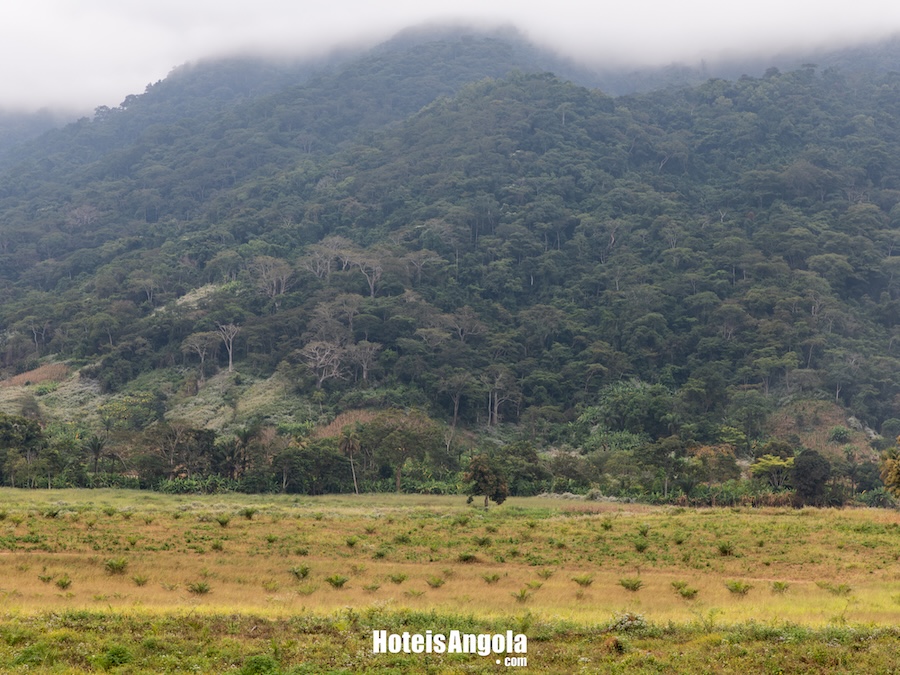
An extraordinary forest survives on the humid slopes of Cuanza Sul, inhabited by some of the rarest birds in Angola and by a small nocturnal primate that received its scientific name from this place.
Cumbira Forest is one of Angola’s great natural treasures, but also one of its most vulnerable.
At dawn, before the first light has fully filtered through the treetops, Cumbira Forest comes alive with sound. Deep within the dense vegetation, birds found only in Angola can be heard, while small animals move quietly among the branches, leaves and old coffee plantations.At night, a small, large-eyed primate moves through the forest, communicating through a distinctive call that gradually rises in pitch. This is the Cumbira galago, a species formally recognised by science only in 2017, whose scientific name is forever linked to this Angolan forest.
Located in the Gabela region, near the municipality of Conda in Cuanza Sul province, Cumbira forms part of the forests of the Angolan Escarpment. These forests are among the country's most important ecosystems for biodiversity conservation, owing to their high concentration of endemic species and the limited areas in which many of them can survive.
A tropical forest isolated on the Angolan Escarpment
The Angolan Escarpment is an extensive transition zone between the coastal lowlands and the central highlands. Differences in altitude, temperature and humidity have allowed pockets of tropical forest to develop in certain areas, surrounded by drier landscapes.Cumbira is one such forest. Botanical studies describe it as an isolated fragment of vegetation with affinities to the Guineo-Congolian biome, the vast forest region that extends across parts of Central and West Africa.
Its relative isolation from other forests has created highly distinctive conditions. Over thousands of years, some animal and plant populations remained separated, favouring the emergence of species with restricted ranges and distinctive characteristics.
Cumbira is not, however, a completely continuous or untouched forest. Its landscape is now a mosaic of:
• areas of relatively well-preserved forest;
• secondary forest and regenerating vegetation;
• old coffee plantations;
• agricultural fields and previously cultivated areas;
• waterways, humid valleys and areas of dense vegetation.
In a botanical survey published in 2016, researchers identified four main vegetation types and collected more than one hundred specimens of flowering and fruit-bearing plants. The study recorded two Guineo-Congolian plant species for the first time in Angola, a new genus record for the country, as well as several specimens that required further research to be properly identified.
These findings do not mean that Cumbira is home to only around one hundred plant species. They represent the specimens that could be collected during a limited scientific survey. The forest's true botanical diversity is likely to be considerably greater.
Conda, Angola
Map
Alojamento
Cuanza-Sul surrounding area
- from kz 49,000Emirais Hotel Spa
- from kz 59,910Hotel Kalunda
- from kz 46,800Hotel Ritz Sumbe
- from kz 27,000Hotel Ritz Waku-Kungo
- from kz 24,000Hotel Aanisa Ritz
- from kz 25,000Hotel Fazenda Cabuta
Support Line
 WhatsApp
 Telephone
 Email
Available every day from 8:00 AM to 10:00 PM. Allows you to clarify doubts, support reservations, and guide you in choosing the best accommodation and tourist services.