- Hotels
- Rent-A-Car
- Routs
Kandumbo Stones
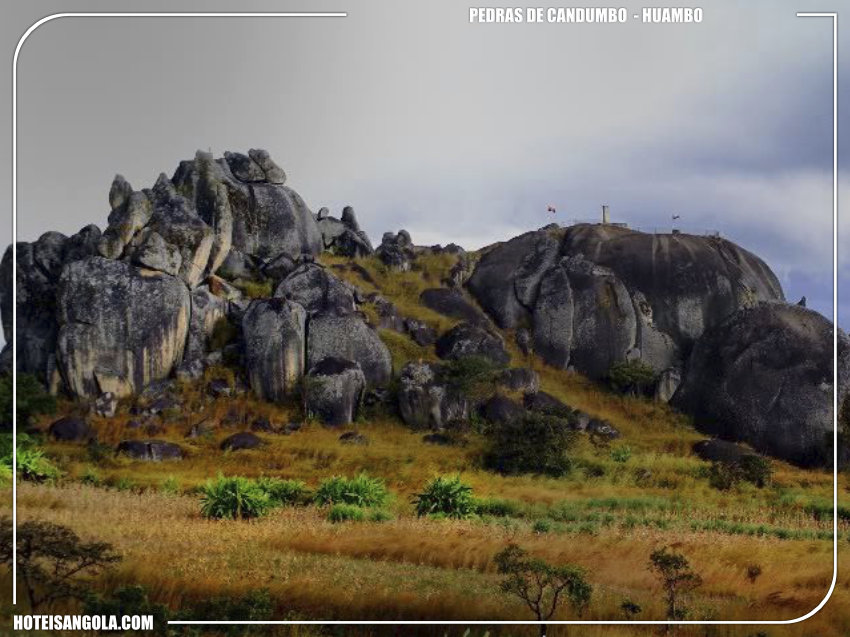
The natural monument of the Kandumbo stones, with cracks, caves and a cave measuring about 300 meters long where the skulls of three of the most dignified sovereigns of the Kandumbo ombala, Santos, Nondolko and Ndala Kandumbo, are buried
Twenty-five kilometers from Huambo, heading toward Bié, rises a colossal granite massif that served as the stage for titanic battles waged by Soba N'Dala against Portuguese colonizers; this formation is the magnificent natural stronghold known as the Pedras do Kandumbo.
The Huambo people, having previously suffered defeats at the Embala do Huambo (near Soque) and later at Pedras da Ganda and Kané (near Kaála), pinned all their remaining hopes on this natural fortress, on the great chief N'Dala (known as "The Viper"), and on his war commanders: Kalley, Kassango, Tchipulowando, and Tchinlundulo.
The year was 1902, and white colonizers, aided by a Boer force, laid siege to the Kandumbo Fort; The battle lasted three days and four nights of ceaseless gunfire, at the end of which-on September 20, 1902-Captain Teixeira Moutinho of the colonial army ordered the final shots to be fired from two 70mm cannons against the people.
The Portuguese Army-aided by the Boers, their cannons, and the treachery of a Soba who showed the besiegers how to penetrate the Natural Fort—won the Battle of Kandumbo.
N'Dala lay dead near the outer palisade.
N'Dala was succeeded by Nondolo, Kachikwala, Xilundulo, Sambuanda, and Samokoloco.
The skulls of N'Dala and his successors, with the exception of Sambuanda and Samokoloco, rested in a triangular reliquary known as a Kalunda.
The huts of N'Dala and the Tchimbanda Samakaka were rebuilt, along with the small Etambo temple and some of the huts belonging to the warriors and their wives.
The Huambo people, having previously suffered defeats at the Embala do Huambo (near Soque) and later at Pedras da Ganda and Kané (near Kaála), pinned all their remaining hopes on this natural fortress, on the great chief N'Dala (known as "The Viper"), and on his war commanders: Kalley, Kassango, Tchipulowando, and Tchinlundulo.
The year was 1902, and white colonizers, aided by a Boer force, laid siege to the Kandumbo Fort; The battle lasted three days and four nights of ceaseless gunfire, at the end of which-on September 20, 1902-Captain Teixeira Moutinho of the colonial army ordered the final shots to be fired from two 70mm cannons against the people.
The Portuguese Army-aided by the Boers, their cannons, and the treachery of a Soba who showed the besiegers how to penetrate the Natural Fort—won the Battle of Kandumbo.
N'Dala lay dead near the outer palisade.
N'Dala was succeeded by Nondolo, Kachikwala, Xilundulo, Sambuanda, and Samokoloco.
The skulls of N'Dala and his successors, with the exception of Sambuanda and Samokoloco, rested in a triangular reliquary known as a Kalunda.
The huts of N'Dala and the Tchimbanda Samakaka were rebuilt, along with the small Etambo temple and some of the huts belonging to the warriors and their wives.
Boas Águas, Kandumbo, Angola
Localização
- Localiddae: Boas Águas
- Municipio: Kandumbo
- Coordenadas GPS: -12.736574406808781,15.973231384243002
Map
Alojamento
Huambo surrounding area
- from kz 44,850Hotel Ekuikui I
- from kz 35,500Hotel Roma Ritz
- from kz 39,000A Residencies
Support Line
 WhatsApp
 Telephone
 Email
Email
Available every day from 8:00 AM to 10:00 PM. Allows you to clarify doubts, support reservations, and guide you in choosing the best accommodation and tourist services.
Next article
Huambo Municipal Anthropological Museum